5 Alternate explanations
5.1 Correlations
Major learning objective(s) for this section:
- Know what a correlation is.
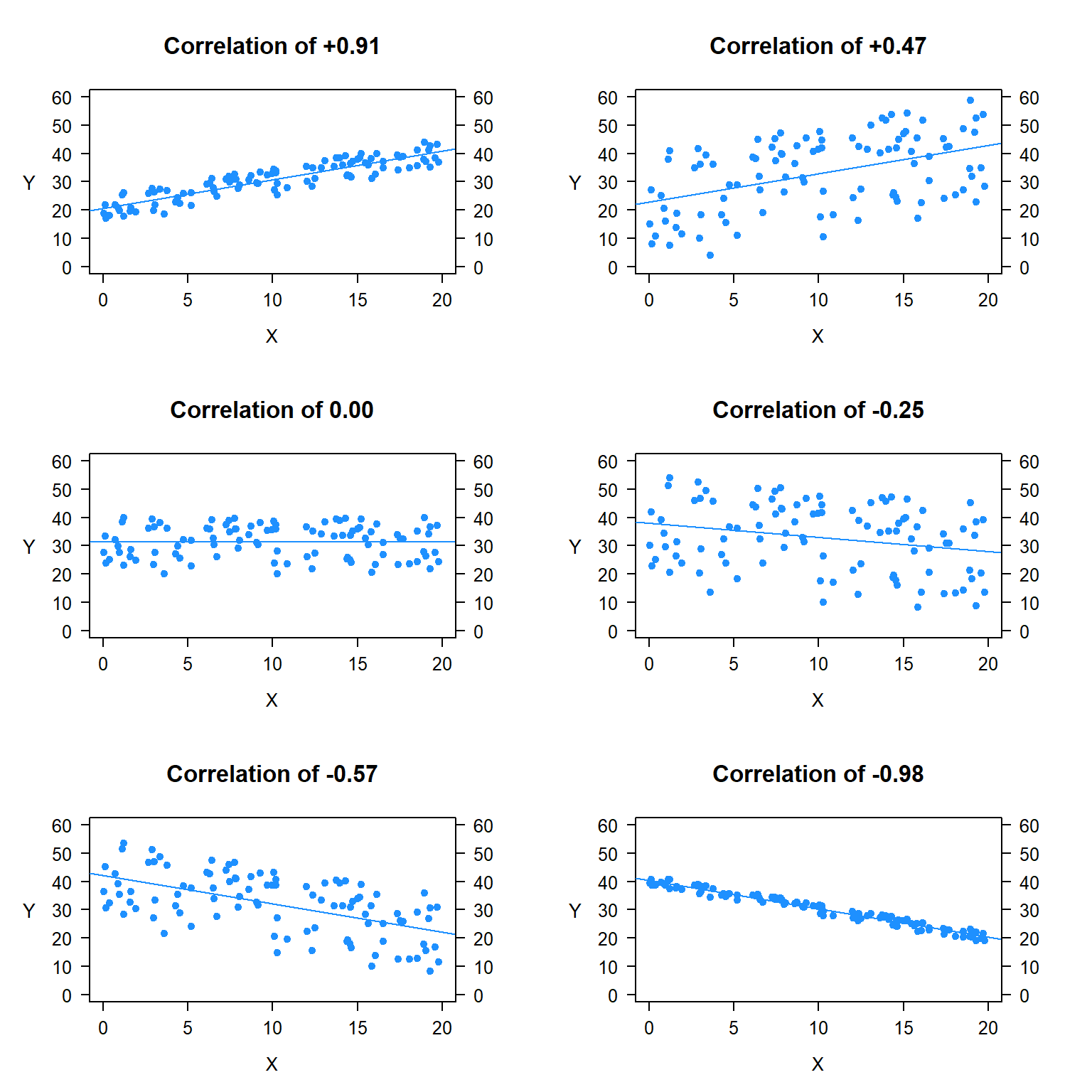
A correlation is association between one variable and another variable. For positively correlated variables, higher values of one variable tend to associate with higher values of the other variable (or you can think of it as lower values of one variable tending to associate with lower values of the other variable). For negatively correlated variables, higher values of one variable tend to associate with lower values of the other variable. A zero correlation is when the variables do not associate with each other. The stronger the association, the farther the correlation is from zero, as indicated in the plots below:
5.2 Alternate explanations
Major learning objective(s) for this section:
- Recognize that correlation does not necessarily indicate causation.
- Propose an explanation for a correlation between two variables, other than variation the first variable causing variation in the second variable.
In this POL 138 course, we will discuss ways to make good inferences and ways to avoid bad inferences. A common bad inference is to use a correlation to infer causation. An observed correlation might be due to a causal association, but we use the phrase “correlation does not necessarily mean causation” to indicate that a correlation might be due to other factors. For example, people who exercise might weigh less on average than people who do not exercise, but people who exercise might eat fewer calories than people who do not exercise. Therefore, we will not know the extent to which a difference in weight between these two groups is due to exercise or is due to how many calories each group eats. Thus, we will not be able to isolate the effect of exercise from the effect of diet.
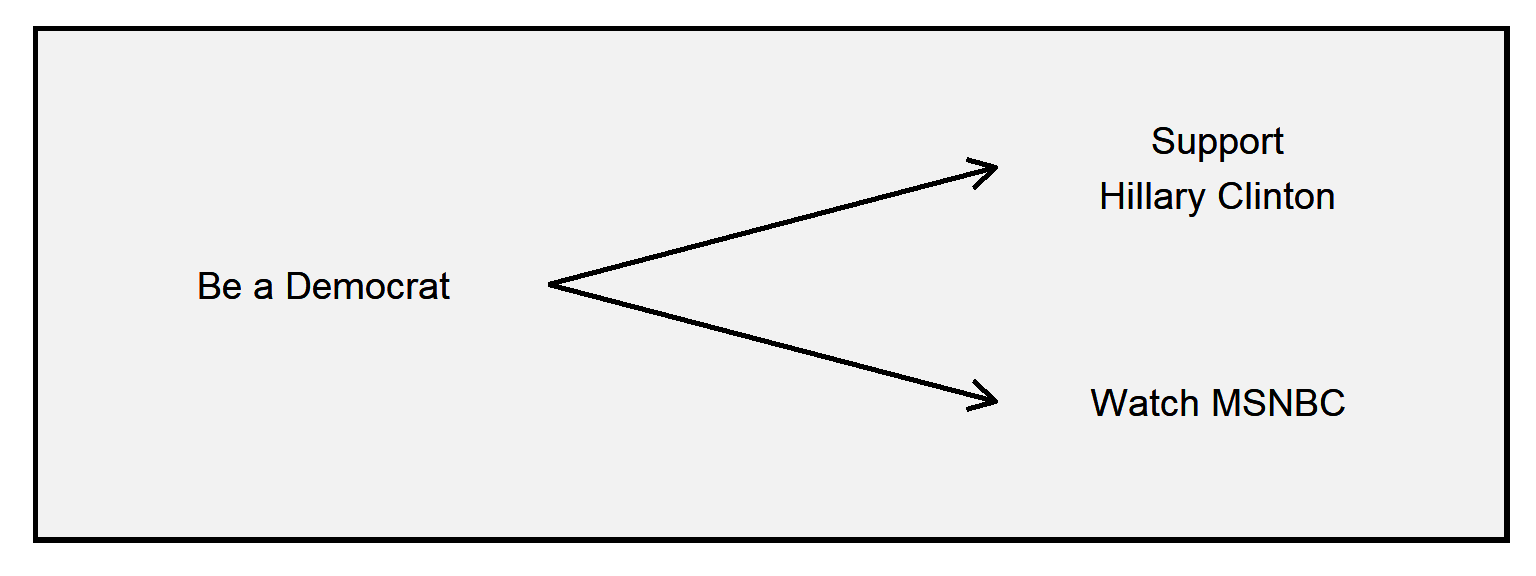
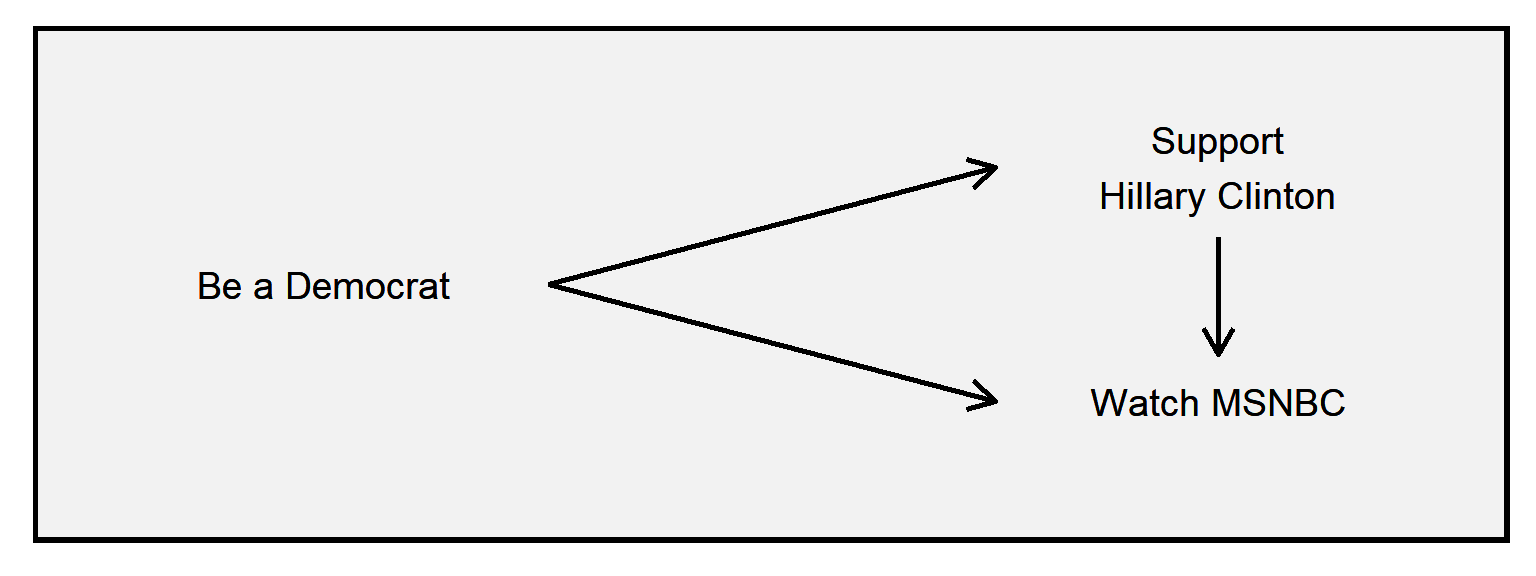
For another example, data from the American National Election Studies 2016 Time Series study indicated that participants who reported that they regularly watch MSNBC were much more likely to vote for Hillary Clinton in the 2016 U.S. presidential election, compared to participants who reported that they do not regularly watch MSNBC. We might be tempted to infer from these data that regularly watching MSNBC caused these participants to be more likely to vote for Hillary Clinton. But that might be an incorrect inference: instead, maybe the association was instead caused by Hillary Clinton supporters deciding to regularly watch MSNBC. Based only on the association between regularly watching MSNBC and voting for Hillary Clinton, we don’t know which of the following is true:
- Watching MSNBC causes a higher likelihood of supporting Hillary Clinton.

- Supporting Hillary Clinton causes a higher likelihood of watching MSNBC.

- Being a Democrat causes a higher likelihood of supporting Hillary Clinton and causes a higher likelihood of watching MSNBC.
And maybe more than one of these is true!
Political scientists have a few ways to address alternate explanations, some of which we will discuss in the upcoming chapters.
Sample practice items
True or false? If two variables are highly correlated, then increasing the value of one of the variables will necessarily cause the value of the other variable to change.
- True
- False
Answer
- False
Correlation does not necessarily indicate causation.
Suppose that you conduct a survey of 3,000 U.S. residents and discover that U.S. residents who watch the PBS NewsHour have higher political knowledge than U.S. residents who do not watch the PBS NewsHour have. One potential explanation for this association is that a U.S. residents’ watching of the PBS NewsHour increases their political knowledge. Provide an alternate explanation for why U.S. residents who watch the PBS NewsHour have higher political knowledge than U.S. residents who do not watch the PBS NewsHour have.
Answer
- No
Maybe U.S. residents with high levels of political interest learn more about politics and the high level of political interest causes these U.S. residents to be more likely to watch the PBS NewsHour. In other words, maybe U.S. residents who watch the PBS NewsHour had more political knowledge than other U.S. residents, even before deciding to watch PBS NewsHour.
Data for the SAT critical reading test in 2016 indicated that the average score was 494 among all SAT test-takers but was 561 among SAT test-takers who had had coursework in Latin. Can we therefore validly conclude that taking Latin caused these students to have a higher score on the SAT critical reading test in 2016, at least on average?
- Yes
- No
Answer
- No
For example, in 2016, SAT test-takers who had coursework in Latin did a lot better than the average SAT test-taker did on the SAT math test: an average SAT math score of 559 for SAT test-takers who had coursework in Latin, compared to an average SAT math score of 508 for all test-takers. it doesn’t seem reasonable that taking Latin caused students to get substantially better at math, but it does seem plausible that a higher average intelligence (or work ethic, for that matter) could cause students who take Latin to outperform other students on the SAT.
Suppose that researchers randomly select 900 sociology majors who are in their fourth year of college and randomly select 900 business majors who are in their fourth year of college. Each of these majors is asked to indicate their political ideology. The data indicate that the average political liberalism among the sociology majors is higher than the average political liberalism among the business majors. One possible reason for this association is that majoring in sociology causes students to be more politically liberal on average, compared to majoring in business. Provide an alternate explanation for why average political liberalism among the sociology majors was higher than the average political liberalism among the business majors.
Answer
One potential alternate explanation is that the sociology majors were more politically liberal than the business majors even before these students decided which major to choose, and it might have been political liberalism among liberal students that caused these students to be more likely to select sociology as a major instead of selecting business as a major.The National Fire Protection Association reported that the risk of dying in a home fire is 55% lower in homes that had a working smoke alarm, compared to homes that did not have a working smoke alarm. Does this mean that, if each home that does not currently have a working smoke alarm installs a working smoke alarm, the risk of a person in these homes dying in a home fire will decrease by 55% on average?